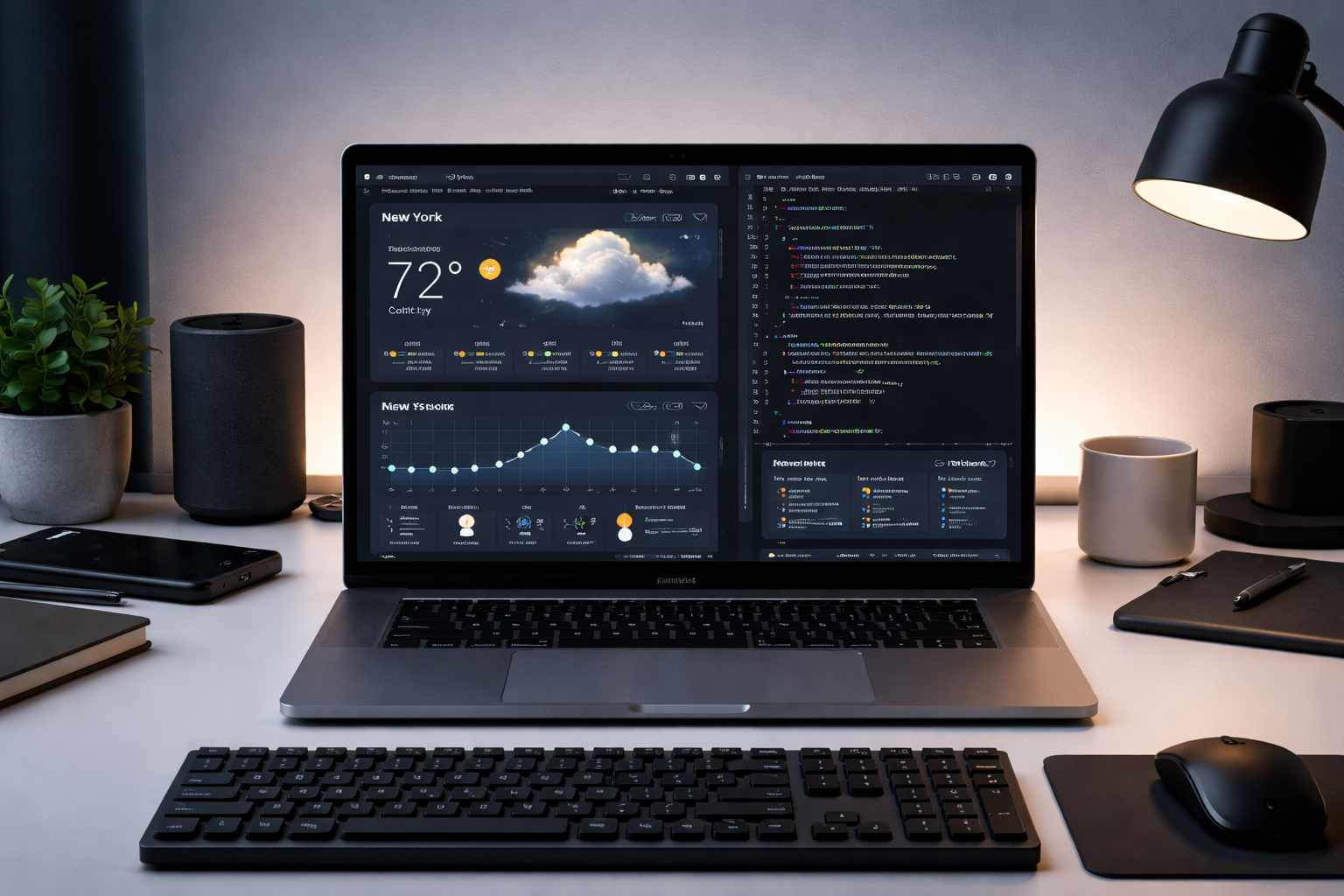

As developers, we often build projects to learn—but every now and then, a project becomes a real benchmark of our skills.
This was exactly the case with my weather forecast dashboard.
What started as a simple idea—“let’s build a weather app”—quickly evolved into a production-ready full-stack application using modern technologies like Next.js 14, Bun, and TypeScript.
In this post, I’ll walk you through my experience, key decisions, challenges, and what I learned along the way 👇
🌦️ The Idea Behind the Project
Living in a fast-paced environment, I wanted a dashboard that:
- Shows real-time weather data
- Provides clean and interactive UI
- Works seamlessly across devices
- Feels like a premium product, not just a demo
But I didn’t want just another weather app—I wanted something that reflects real-world engineering practices.
🛠️ Tech Stack & Why I Chose It
⚡ Next.js 14 (App Router)
The backbone of the app.
- Server Components for performance
- Route Handlers for secure API calls
- Clean separation between client and server
🧪 TypeScript
Strict typing helped me:
- Avoid runtime bugs
- Build scalable architecture
- Improve maintainability
🚀 Bun Runtime
I wanted to experiment with performance.
- Faster installs
- Lightweight runtime
- Modern developer experience
🎨 Tailwind CSS
For rapid UI development:
- Utility-first workflow
- Fully responsive design
- Easy dark mode integration
🧠 Architecture Decisions That Made a Difference
🔐 Server-Side API Handling
Instead of exposing API keys on the client:
- All requests go through server-side route handlers
- Keeps secrets safe
- Improves security 🔒
⚡ Smart Caching Strategy
I implemented a custom in-memory cache (10-minute TTL):
- Reduces API calls
- Improves response time
- Enhances user experience
This was a small feature—but it made a huge performance impact.
💾 Lightweight Data Persistence
Instead of jumping directly to a database:
- I used a JSON-based storage system for recent searches
It’s:
- Simple
- Fast
- Easy to maintain
⚠️ However, I learned an important lesson when deploying:
Serverless platforms like Vercel have ephemeral storage
Meaning:
- Data may reset
- Not suitable for long-term persistence
🎨 UI/UX: Small Details Matter
I focused heavily on user experience:
- 🌙 System-aware dark mode
- ⏳ Skeleton loaders for smooth loading
- 📱 Mobile-first responsive design
- 📊 Interactive charts for temperature trends
These touches transform a project from:
“just functional” → to “pleasant to use”
🧪 Testing & Reliability
One thing I didn’t want to skip: testing
I implemented:
- ✅ 38 unit & integration tests using Vitest
This gave me:
- Confidence in the code
- Safer refactoring
- Better structure overall
⚠️ Challenges I Faced
1. Serverless Limitations
Handling persistent data in a serverless environment wasn’t straightforward.
2. Performance vs Complexity
Balancing:
- Clean architecture
- Performance optimization
…without over-engineering
3. UX Polish
Making the app feel smooth and professional took more time than expected.
🔮 What I’d Improve Next
If I continue this project, I’d:
- Replace in-memory cache with Redis
- Use PostgreSQL instead of JSON storage
- Add authentication & user-specific data
- Turn it into a PWA (offline support)
- Add multi-language support (important for users in Jordan 🌍)
💡 Key Takeaways
This project reinforced a few important lessons:
- ✅ Real-world apps need more than just UI
- ✅ Performance and architecture matter early
- ✅ Testing is not optional in serious projects
- ✅ Simplicity (like JSON storage) can be powerful
🔗 Live Demo & Code
You can check the project here:
- 🌐 Live Demo: https://weather-forecast-dashboard-sable.vercel.app/
- 💻 GitHub: https://github.com/mo73rfat/Weather-Forecast-Dashboard
🧾 Conclusion
Building this weather dashboard was more than just another project—it was a step toward building production-ready applications with confidence.
If you’re a developer, I highly recommend:
👉 Take a simple idea
👉 Push it to production quality
That’s where real growth happens.
📣 If you found this useful:
- 💬 Let me know your thoughts
- ⭐ Check out the repo and give it a star
- 🚀 Explore more projects on my portfolio
